The Most Expensive Place to Put an Engineer
Jeremy McEntire
Wander9 min read
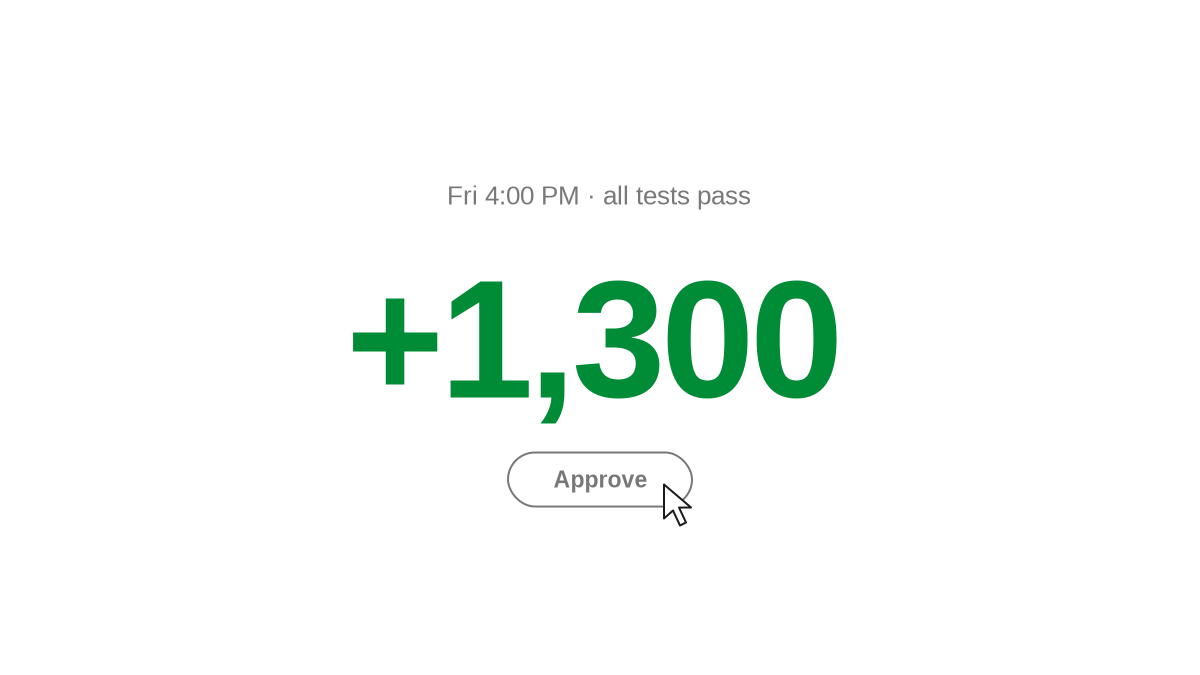
A pull request arrives at four on a Friday. An agent wrote it. It is 1,300 lines long and the tests pass. The same agent wrote the tests. You open the diff and scroll. The shapes look right. You approve.
You read it. You did not verify it. Nobody holds 1,300 lines of someone else's logic in their head at four on a Friday.
We know the scene because we built it. Our first attempt at an AI software factory handed our engineers more code to review than it saved them from writing. We held retrospectives. The agents had not written bad code. We had put our people in the wrong place.
The queue moved
Code used to be expensive to write, and the expense did useful work. It forced a team to decide what it was building before anyone typed. Then writing became nearly free. The cost did not vanish. It moved one station down the line, to a person reading a diff at the speed a person reads.
The research outside our walls tells the same story. In one study, developers with an AI assistant finished a small, self-contained task in about half the time.1 In another, experienced maintainers working in code they knew well felt faster with AI, and the clock said they were slower.2 A third looked across thousands of developers. The teams leaning hardest on AI merged far more pull requests, and those pull requests were more than twice the size and took nearly twice as long to review.3
| Who was asked | Change in time to finish a task (%) |
|---|---|
| Economists | -39 |
| ML experts | -38 |
| Developers before | -24 |
| Developers after | -20 |
| Measured | 19 |
Those findings agree with each other. Generation sped up and checking did not. Speed up one station and leave the next alone, and you get a pile.
| Measure | Change with high AI adoption (%) |
|---|---|
| Tasks completed | 21 |
| Pull requests merged | 98 |
| Pull request size | 154 |
| Review time | 91 |
What the reader is looking for
So we asked what an engineer is looking for in that diff.
Mostly one thing: is it correct? Good names and tidy structure matter to the person who will change the code by hand. If the next change is also made by an agent working from the same specification, the thing that has to be legible is the specification. Legibility was a means to correctness when people wrote the code. Correctness is the thing we are buying.
The tests in the Friday pull request could not settle it either. They were written by the author, after the code, and every engineer has met that suite. It asserts whatever the function happened to return. It shows that the code does what the code does.
What settles it is a statement of what must be true, made by someone who knows the business, and a test that tries to break it. Here is one of ours: a guest is never charged for dates that were not confirmed. No amount of reading establishes that. A test that attacks it on every change does.
Most of us have worked for the tech lead who rewrote every pull request the team opened. That lead was the bottleneck, and the team never grew. The leads we remember well set the bar, asked hard questions early and checked outcomes. We've found that is the useful posture toward an agent. Our engineers direct the solution. They do not type it, and they do not proofread it.
This costs something. The work moves to the front, where it is harder. If the statement of what must be true is wrong, the factory builds the wrong thing quickly and with confidence. And the engineer gives up the comfort of having read every line.
Where we moved the human
We kept a person in the loop. We changed where the person stands.
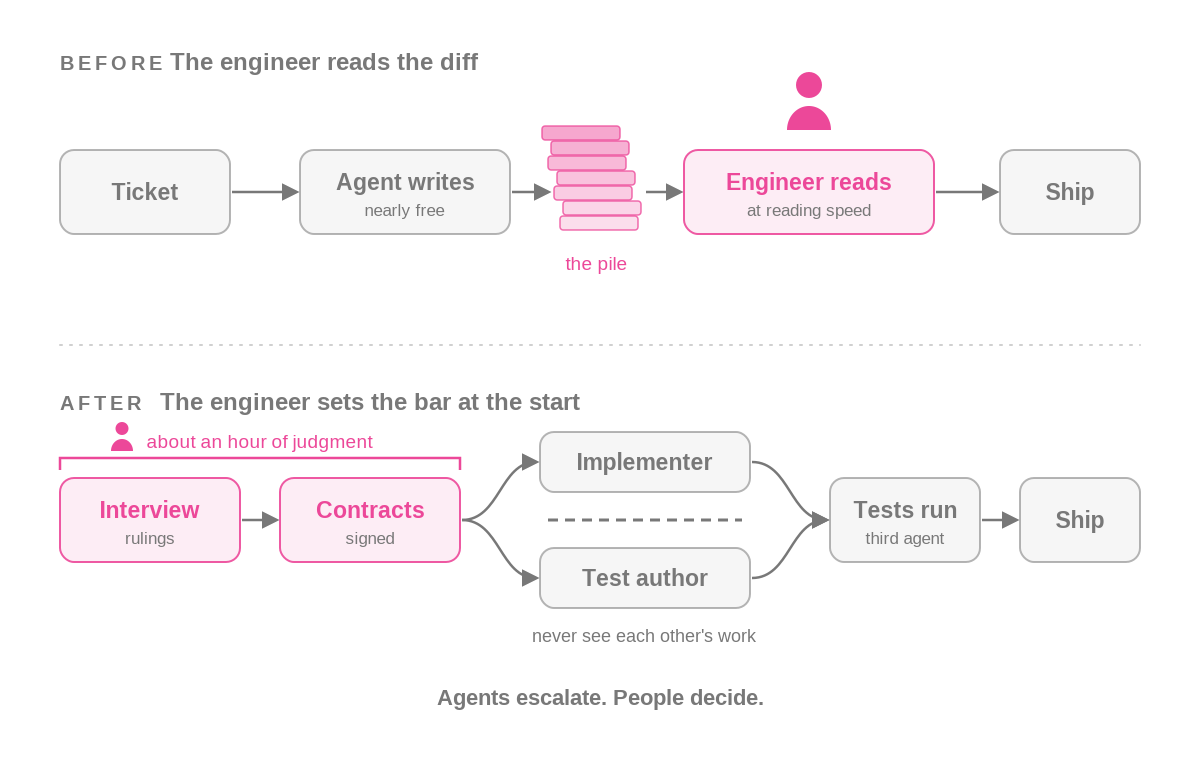
You have built exactly what the ticket said and then heard the requester say that it isn't what they meant. So the work starts with an interview. Constrain questions the engineer about the feature, and its most useful move is to name the gap between what was asked for and what is required. Two adversarial reviewers attack the result. The agent lists every decision it made on its own and every question it cannot answer, and a person rules on each.
You have also lived integration day, when two teams who built from the same document find that their halves do not fit. Pact exists to make that day dull. It splits the plan into components and writes down, for each one, what it accepts, what it returns and how it fails. No code is written at this stage. The contracts have one standard to meet: two parties who cannot talk to each other must be able to build and test the same thing from them.
Then we hold the contracts to that standard. One agent writes the code. Another writes the tests from the same signed contracts. Neither sees the other's work. A third runs the tests.
That separation came from a result we did not expect. In the work our factory is built on, three agents reviewed the same stories. They caught interface mistakes reliably. They caught no conceptual mistakes, because all three shared the same wrong picture of the problem. It was the design review where everyone approves, and everyone was in the same kickoff meeting. Three copies of one opinion is one opinion. What caught the conceptual errors was separation: an implementer and a test author who never see each other's work, and reviewers told to refute a claim instead of confirming it.
More reviewers did not help. In an earlier experiment, a pipeline of eleven agents with review gates between them spent its whole budget debating the plan and wrote no code. The same model, working alone, solved the task. Most of us have been staffed on that project too. Review by opinion is a bottleneck whoever does it.
A common recommendation is to gate AI-written changes with a human reading the diff. We've found the diff is the most expensive place to put an engineer, and the place where their judgment buys the least.
What a good start buys
Three weeks into a build, you call another team's endpoint and learn that it was on their roadmap and never in their service.
Our messaging service had been built once already. That build came back wrong and we set it aside. Before the second attempt wrote a line, the agent took every call the design made to another service and went to see whether the other service offered it. There were eleven. Nine did not exist.
| Category | Calls in the design |
|---|---|
| Did not exist | 9 |
| Existed | 2 |
Nine missing endpoints, found before any code, became nine questions a person could answer. The planning that followed took four review rounds and less than five dollars of compute.
On a bug ticket, the agent named a root cause, then checked the git history and found the behavior had been put there on purpose, with a test that said so. It withdrew its diagnosis, gave the engineer two options and changed nothing. Anyone who has "fixed" a colleague's deliberate decision knows what that saved.
In our demonstration runs, the blind implementer and tester found two defects in the specification we had written ourselves.
A second new service took three to five days of unattended work and about an hour of one engineer's attention. It is not in production yet.
Each of those is a decision reaching a person early, when it is cheap. An hour of judgment at the start replaced days of reading at the end.
What our engineers asked for
We sat down with engineers across our teams and asked what they wanted from a factory. Most had worked with an earlier version, and much of what they asked for was what it lacked. Their list is close to the design of the one we are publishing.
Ask me first, then leave me alone. They wanted to be questioned about a feature before a specification existed, and to have the agent dig up the edge cases, bring back options and wait. After that they wanted it to go away and work. That is the interview and the list of rulings described above.
Stop making me repeat myself. An agent is a new hire every morning. It needs the tour again: why the service is shaped this way, which pattern to copy, and which one is a mistake nobody has cleaned up. Much of that lives in someone's head, and written plans go stale within a month. Kindex is a local knowledge graph that every coding agent reads and writes, whichever vendor made it. It keeps decisions with their reasons, and constraints that block an action before it happens. Kinbase is the layer above it for the whole company, with a named owner for each area, so the agent learns what a good new hire learns first: who to ask.
One engineer opened a factory-built repository and asked what half the files were. They were not production code. They were the factory's notes on what it was doing and what it decided, kept in the repository on purpose. Anyone who has inherited a service from someone who left no notes will see the use.
Take the boring work completely. Every backlog has a framework upgrade that has sat at the bottom for a year. They wanted to hand that over and not think about it again. That kind of work checks itself: it builds or it doesn't. Amazon has said upgrades like it saved thousands of developer-years.4 The unattended half of the factory is built for this.
Don't turn the lights off. Nobody asked for a factory that runs without them. One engineer said the companies that go lights-out end up turning one light back on. We agree. In our factory, agents escalate and people decide.
Nobody asked for more code to read.
What we have not solved
Old code is harder than new code, and the reason is not model quality. The facts an agent needs are often not in the code. Kinbase passes its acceptance suite. Whether it improves real work on old code is not yet shown.
Trust is not solved either. Several of our engineers still read every line an agent writes. They answer for that code in production, and a system that has not yet shown them its evidence has not earned the benefit of the doubt. No team at Wander is required to accept the factory's work. The factory has to earn it.
And we could be wrong about the diff. If services built this way produce more escaped defects than the ones we review by hand, we are.
Why we are publishing
Our business is vacation rentals, not developer tools. The factory, Kindex and Kinbase are published under the Business Source License 1.1 because this work improves faster when other people run it and break it.
- Kindex: https://kindex.tools
- Kinbase: https://github.com/wandercom/kinbase
- Factory: https://github.com/wandercom/factory
The pull request will still arrive at four on a Friday. We want the engineer's judgment to have been spent earlier in the week, on the questions only they could answer. This is what we have found so far.
References
- The Impact of AI on Developer Productivity: Evidence from GitHub Copilot (Peng, Kalliamvakou, Cihon & Demirer, 2023)
- Measuring the Impact of Early-2025 AI on Experienced Open-Source Developer Productivity (Becker, Rush, Barnes & Rein, 2025)
- The AI Productivity Paradox Report (Faros AI, 2025)
- Amazon Q Developer just reached a $260 million dollar milestone (AWS, 2024)