Kindex: shared memory for every agent
Alex Ungureanu
Wander8 min read
Memories on ruled rows drifting into the past; questions from four agents route traces from the memories they find to the agent that asked.
Every coding agent remembers for itself, and none of them can read the others. Kindex is the shared memory underneath them: one local knowledge graph that Claude Code, Codex, Gemini CLI, Google Antigravity, OpenCode, Cursor and any other MCP client read and write. It carries decisions, constraints, conversations and code structure across sessions, restarts and vendors, and it coordinates agents that work at the same time.
Kindex F26 is the version we benchmarked; its default answering path shipped in Kindex 0.49.0. Answering through kin ask, its question-answering path, Kindex scores 95.13% on LoCoMo1 and 97.80% on LongMemEval-S,2 above the published scores of the memory systems we compared, while every answer reads under an estimated 20k input tokens: 49% and 88% fewer than the full history. On BEAM, where conversations run to 10 million tokens,3 it scores 80.69% at 1M with default ask settings and 90.61% with the dataset's annotations, the protocol behind past.dev's 90.65%.4 Kindex is available under the Business Source License 1.1 and installs as a plugin or a CLI.
One graph, every agent
Kindex is not a transcript archive with search. It is a weighted graph with typed nodes, provenance and decay, and it decides how much of that graph each agent should see.
- Continuity. Session-start, pre-compaction and stop hooks prime each agent with the context it needs, at one of five tiers from about 100 to 4,000 tokens, chosen by the budget left in its window.
- A typed graph. Concepts, decisions, people, projects, sessions, documents, questions, artifacts and skills are nodes. Edges carry a type, a weight and their provenance, and decay over time.
- Guardrails. Constraints are surfaced to the agent before a push, directives encode standing preferences, watches flag what needs attention and checkpoints run pre-flight.
- Coordination. Agents working at once join a collab, attach the resources they hold, take advisory locks that edits respect, and post targeted or standing messages that appear in each other's context.
- Code intelligence. ctags, cscope and tree-sitter put modules, symbols, imports and call graphs in the same graph as the decisions about them.
- Memory of conversations. The text of every message is stored in full, with its speaker and role, and digested into dated facts, summaries and per-person profiles;
kin askanswers from them. - Scope.
.kinfiles let a service inherit its context from a platform team and an organisation. Nodes are private, team, org or public; public and org exports strip credentials, email addresses and activity actors.
Architecture
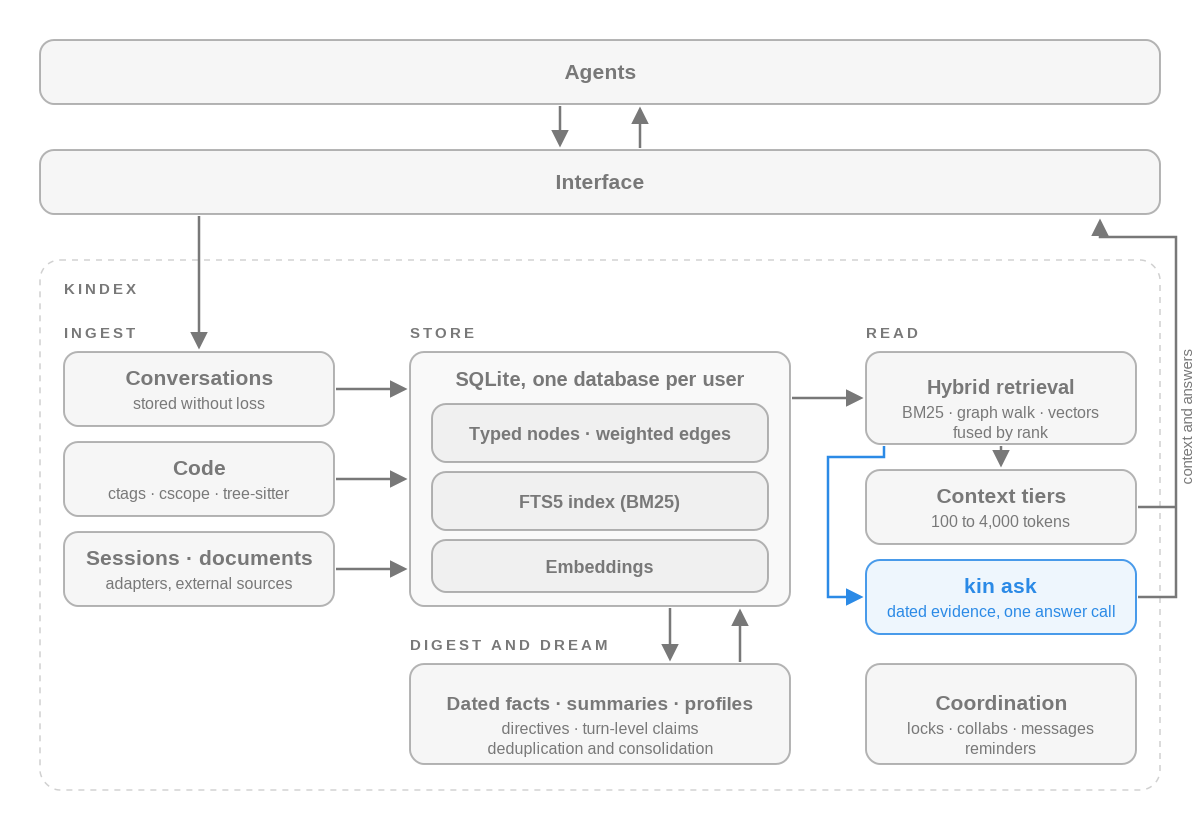
Everything lives in one SQLite database per profile, one per user by default. Nodes and edges are rows; an FTS5 index stays in sync through triggers; embeddings come from a configurable provider (Voyage, OpenAI, Gemini or a local model). Retrieval runs BM25 over FTS5, a breadth-first walk of the graph from the text hits, and vector search, then merges them by a weighted ensemble or reciprocal rank fusion.5 A tier formatter cuts the result to the reader's budget.
kin ask adds an answer on top of retrieval:
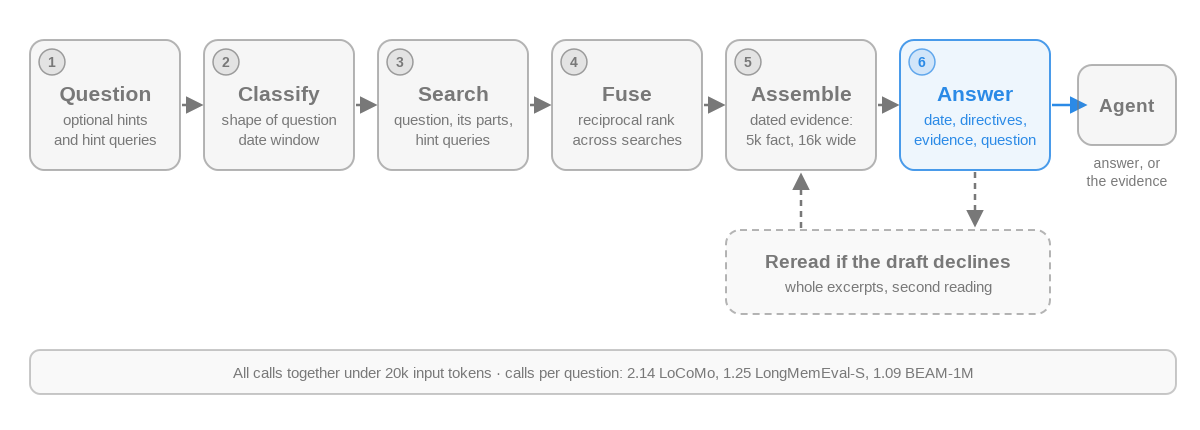
The answer model sees dated, chronologically ordered evidence trimmed to the messages that bear on the question, with relative dates already resolved by the digest. The whole answer, planner and reread included, stays under 20k estimated input tokens: 2.14 model calls per question on LoCoMo, 1.25 on LongMemEval-S and 1.09 on BEAM-1M.
Long-term memory
| Benchmark | Kindex | past.dev | Exabase M-1 | Hindsight | Mem0 | Supermemory | Zep |
|---|---|---|---|---|---|---|---|
| Conversational memoryLoCoMo1,540 questions | 95.13% | 93.12% | — | 92.0% | 92.5% | — | 94.7% |
| Chat-assistant memoryLongMemEval-S500 questions | 97.80% | — | 96.4% | 94.6% | 94.4% | 97.0% | 90.2% |
| Long-history memoryBEAM-1M700 questions | 80.69%without annotations | — | — | 73.9%without annotations | 64.1%without annotations | — | — |
| 90.61%with annotations | 90.65%with annotations | 75.0%with annotations | — | — | — | — |
Sources: past.dev,4 Exabase,67 Hindsight,8 Mem0,9 Supermemory10 and Zep.11 "With annotations" means the answer prompt includes the dataset's annotations for the question. Supermemory's 97.0% is its LongMemEval-S accuracy with gpt-4o answering and judging (85.2% with Gemini 3 Pro).
| Benchmark | Input tokens saved (%) |
|---|---|
| LoCoMo | 48.7 |
| LongMemEval-S | 88 |
| BEAM-1M | 97.8 |
The gains came with the same answer model, not a larger one, though not at identical settings: the full-history baseline answered in one call at reasoning effort high, while Kindex routes LoCoMo and BEAM-1M answers to xhigh and may add a planner call or a second reading. The first kin ask answered from the top 5 to 12 search hits, about 0.7k tokens, without the question's date; it scored 21.23 on LoCoMo. Four changes carried it to F25: dated evidence of the right size, facts written at ingest, the question's date with window search, and settings routed by the shape of the memory (dialogue between named people versus user–assistant transcripts).
Long histories: BEAM
BEAM ships each question with annotations: the topics an ordering question tests, the dates and arithmetic behind a temporal question, the rubric points a summary should cover, the preference under test, and why an abstention question cannot be answered. Exabase's published answer prompt adds them to the question, and past.dev uses that prompt.64 The F26 benchmark build (tag benchmark-f26) lets a caller pass guidance with a question: answer_question(hints=..., hint_queries=...), with ask.hint_mode: lead_both placing the hints before and after the evidence. That interface exists only in the benchmark build and was not released; LoCoMo and LongMemEval-S do not use it (95.13 and 97.80 on F26).
| System | Without the annotations | With the dataset's annotations* |
|---|---|---|
| Kindex | 80.7 | 9.92 |
| past.dev* | 0 | 90.7 |
| Exabase M-1* | 0 | 75 |
| Hindsight | 73.9 | 0 |
| Mem0 | 64.1 | 0 |
With the annotations Kindex is within 0.06 of past.dev at 500K and 1M, and below it at 100K (−0.42) and 10M (−0.88).
The annotations help where they carry question-specific content. Ordering, temporal reasoning, summarization and abstention gain 16 to 28 points; extraction, knowledge updates and multi-session reasoning, which receive only generic guidance, do not move. That is why these scores carry an asterisk: the annotations encode part of what the judge checks, and a user's question does not arrive with them.
| Ability | Change with the annotations (pts) |
|---|---|
| EO | 28 |
| TR | 22.9 |
| SUM | 21.3 |
| ABS | 15.8 |
| PF | 7.02 |
| CR | 5.77 |
| IF | 0.82 |
| KU | 0.36 |
| MS | -0.87 |
| IE | -1.89 |
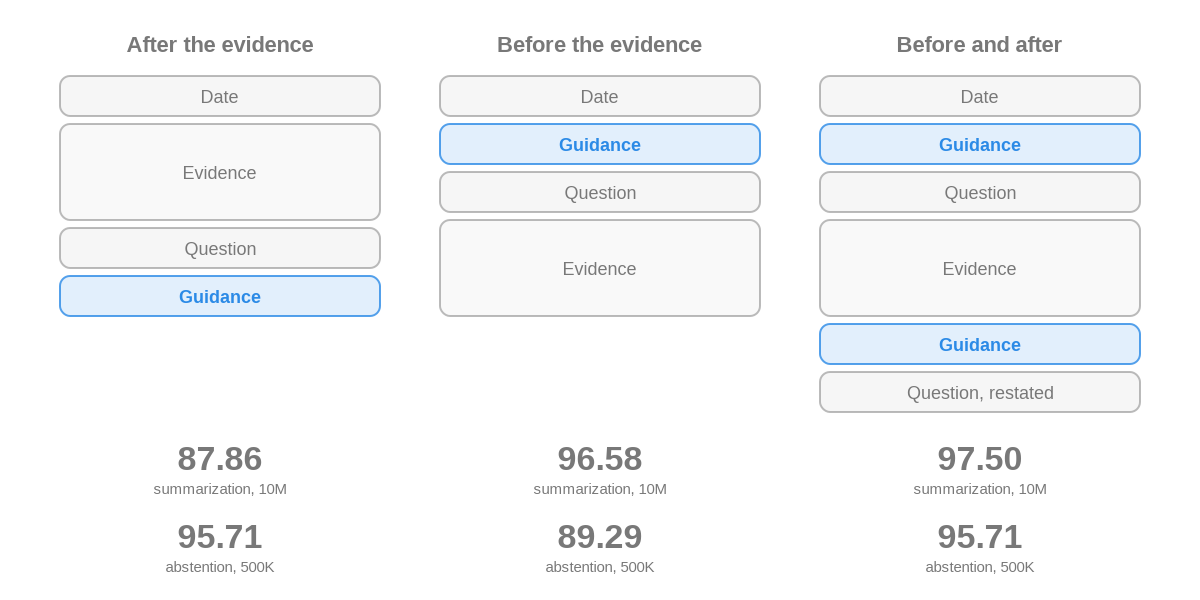
Where the guidance sits mattered as much as what it said. After the evidence, rubric points read as claims to verify, and the model reported the ones it could not confirm as missing: 10M summarization scored 87.86. Before the evidence only, the model sometimes answered an earlier request quoted in the evidence, and 500K abstention fell from 95.71 to 89.29. Before and after, with the question restated, scored 97.50 and 95.71. Two category settings also held up: contradiction questions keep Kindex's own answering rules (77.3 against 71.2 with Exabase's prompt at 10M), and per-conversation facts beat turn-level claims at 500K (88.93 against 87.76), while claims help at 1M and 10M with the annotations. Without the annotations, claims in place of facts lowered default Kindex on LoCoMo (93.44), LongMemEval-S (96.40) and BEAM-1M (79.56); they are off by default.
Models and reasoning
Default settings here means Kindex 0.49.0's default ask settings with gpt-6-luna as the answer model; a fresh install leaves LLM answering off and defaults to Claude Haiku. Later versions default to lighter settings for agents and keep these as a patch, docs/benchmarks/benchmark-defaults.patch. Kindex answered with gpt-6-luna under its default reasoning routing: medium for a direct question, high when the answer needs a count, a date, an ordering, an update or a summary, and xhigh for every answer when the memory is a dialogue between named people or holds more than 1,000 nodes. The query planner runs at low. The runs with BEAM's annotations used past.dev's answer model, gpt-5.6-luna, with reasoning off.
| Run | Answer model | Reasoning effort | Judge |
|---|---|---|---|
| LoCoMoKindex, default settings | gpt-6-luna | xhighevery answer: a dialogue between named people | gpt-4o-miniMem0's accuracy prompt |
| LongMemEval-SKindex, default settings | gpt-6-luna | medium or highhigh for counts, dates, orderings, updates and summaries | Gemini 3 Flashunified judge |
| BEAM-1MKindex, default settings | gpt-6-luna | xhighevery answer: over 1,000 nodes | Gemini 3 Flashnugget rubric |
| BEAM-1MKindex with the annotations | gpt-5.6-lunapast.dev's answer model | noneevery call | gpt-5.6-lunapast.dev's judge, reasoning off |
Limitations
- Annotations. Starred BEAM scores use information a user does not provide. Default Kindex scores 80.69% on BEAM-1M.
- Judges. Default BEAM runs use the nugget rubric on Gemini 3 Flash; starred runs use past.dev's judge. Re-scoring past.dev's published answers with our run of their judge gives 91.39, 88.87, 90.17 and 84.27 at 100K, 500K, 1M and 10M, 0.5 to 0.8 below their published figures. Against that common judge run, Kindex's differences are +0.27, +0.70, +0.44 and −0.12 points at 100K, 500K, 1M and 10M; against the published figures they are −0.42, −0.06, −0.04 and −0.88. Differences this small are within run-to-run and judge variation, so neither a lead nor a tie is established.
- Evidence volume. Kindex reads 12k to 16k tokens of evidence per BEAM answer; past.dev's recall is capped near 8k.
- Answer keys. past.dev's LoCoMo score of 93.12% uses community-corrected answer keys (an audit found errors in about 6% of the original answers);12 Kindex's 95.13% uses the original keys. On the corrected keys, Kindex scores 96.30%: its answers to the 99 questions whose keys the audit corrected were judged again against the corrected answers, with the same judge (Mem0's accuracy prompt on gpt-4o-mini, majority of three runs, as the audit does), and the other 1,441 verdicts are unchanged.
- Tuning. Kindex's answer formatting settings were tuned on these benchmarks to account for judges' criteria that expect verbatim responses. An example would be classifying a chandelier as jewelry to match answer key descriptions.
- What the benchmarks test. LoCoMo, LongMemEval-S and BEAM test question answering over conversation histories. They do not test multi-agent coordination, hooks or code memory.
- Variance. BEAM categories move by several points between runs at 70 questions.
- Scope. Kindex is local-first: one database per profile, shared through
.kininheritance and exports. The company-wide layer, Kinbase, is in development.
Availability
Kindex is available under the Business Source License 1.1 at github.com/wandercom/kindex, with documentation at kindex.tools.
Benchmark version. The default-settings scores were measured on Kindex 0.49.0's answering path; in later versions, git apply docs/benchmarks/benchmark-defaults.patch sets those defaults back, and git apply -R undoes it. The BEAM runs with the annotations used the F26 benchmark build (tag benchmark-f26), which adds the caller hints.
pip install 'kindex[mcp]'                       # or: uv tool install 'kindex[mcp]'
claude plugin marketplace add wandercom/kindex  # Claude Code: MCP server, skills and hooks
claude plugin install kindex@kindex
kin setup-codex-mcp && kin setup-codex-hooks    # Codex
Setup commands for Gemini CLI, Antigravity, OpenCode and Cursor are in the README. The benchmark work is in Kindex PR #77 (F25, the default system) and PR #78 (F26: turn-level claims, caller hints and the BEAM configuration), which includes the full report. The shared answer settings for the BEAM runs with the annotations, on the benchmark-f26 build, are below; PR #78's BEAM configuration section lists the per-category overrides (contradiction, knowledge update, information extraction and temporal reasoning), and the 100K and 500K runs read per-conversation facts while 1M and 10M read turn-level claims built with a research version of the claims prompt:
{
  "effort": "none", "hard_effort": "none", "plan_effort": "none", "large_effort": "",
  "hint_mode": "lead_both", "context_tokens": 12000, "wide_context_tokens": 16000,
  "rank_order": true, "fact_sources": true, "position_labels": true
}
References
- Evaluating Very Long-Term Conversational Memory of LLM Agents (Maharana et al., 2024)
- LongMemEval: Benchmarking Chat Assistants on Long-Term Interactive Memory (Wu et al., 2025)
- Beyond a Million Tokens: Benchmarking and Enhancing Long-Term Memory in LLMs (Tavakoli et al., 2025)
- BEAM benchmark results (past.dev, 2026)
- Reciprocal Rank Fusion Outperforms Condorcet and Individual Rank Learning Methods (Cormack et al., 2009)
- Exabase M-1: State of the Art on BEAM at 100K, 1M, and 10M Tokens (Exabase, 2026)
- Exabase achieves state-of-the-art on LongMemEval with a smaller model (Exabase, 2026)
- Hindsight benchmarks (Vectorize, 2026)
- Memory evaluation (Mem0, 2026)
- supermemory is state of the art in agent memory (Supermemory, 2026)
- Benchmarks for agent memory (Zep, 2026)
- LoCoMo answer-key audit (dial481, 2026)